Avoiding OOM Kills in Kubernetes: Switching from DOM to SAX in Elixir
Introduction
TL;DR: Parsing large XML files with SweetXML (DOM-based) caused memory spikes up to 9GiB. Switching to a SAX-based parser (Saxy) reduced memory usage by ~90% and halved runtime.
A key part of the insurance business is deciding who to insure. Many properties are taken into consideration and one of the most important ones is whether an entity - be it a person, vehicle, company and so on - has been sanctioned by some government. Different sanctions lists are kept updated by their respective governments and are available online freely (e.g. the UK Sanctions List). These can be used to determine if an entity is subject to any sanctions and thus if they are - or not - a good candidate to insure.
These lists come in different formats and usually - to be machine readable - they are available as XML documents. These documents can range from a few hundred kilobytes to tens of megabytes and can contain a few thousand up to tens of thousands of entries (with 20k being the largest). Since the lists can be updated frequently and are not always backward compatible, we use a cron job that runs daily and has to download, parse and write all entries to the database.
We managed to nail the downloading and writing ~40k entries to the database part. Unfortunately, we had huge memory spikes during the actual parsing of the XML files, which went as high as 9GiB and averaged 1GiB per run. This meant that we had to either request a lot of memory to Kubernetes just to be safe or risk getting OOM Killed, which started happening too frequently. This situation was not sustainable.
A brief detour into XML parsing
To understand why this was happening, let's back up a bit and take a detour into the wonderful world of XML parsing.
There are at least two ways to parse an XML file: you can load it all up in memory or you can read it as a stream of data. These two modes are called DOM and SAX respectively. They differ in that DOM parsing is more expensive for memory, since it has to read the whole file to create the DOM tree, while SAX parsing reads the file and generates events each time an XML tag is opened or closed. DOM parsing is a lot more ergonomic since you can run queries using XPath, but SAX parsing is more scalable.
In the Erlang ecosystem, the main library for XML parsing is xmerl, which
offers both DOM and SAX modes. Many libraries are based on it and SweetXML,
the library we used, is a thin Elixir wrapper around it. SweetXML, as the name
suggests, is a really sweet library to use but it inherits both merits and
faults of xmerl, namely a high memory footprint, especially when not using the
streaming API. While SweetXML offers options to reduce memory usage, e.g.
element streaming and a discard option to
avoid construction of the whole tree,
it didn't fully solve our problem. This led us to search for solutions
elsewhere.
We had various ideas on how to fix this problem. There are external services that offer solutions to query these sanctions lists, but that didn't make sense for our use case. We also thought about rewriting the import service in Rust, the other main language in Prima, to get that juicy blazingly™️ fast speed. In the end, since we had a lot of machinery written in Elixir already, we decided to try out a SAX parser.
There are quite a few SAX parsers for Erlang/Elixir, like erlsom, fast_xml and yaccety_sax, all of which would probably speed up parsing. Unfortunately, none of those were appealing since the code you end up with is often not that readable and their interface is not that user-friendly. Among these tough, we found Saxy, which proved to be both ergonomic and fast.
From DOM to SAX
The translation from a DOM implementation using XPath to a SAX one is not straightforward, since with XPath you can just query a document whereas with SAX you have to build your internal representation from sequential events.
The key idea is that we build the structure incrementally as events arrive, instead of querying a pre-built tree.
Let's suppose we have a simple XML as input:
<?xml version="1.0" encoding="UTF-8"?>
<teams>
  <team>
      <id>1</id>
      <name>Team One</name>
  </team>
  <team>
      <id>2</id>
      <name>Team Two</name>
  </team>
</teams>
Here are a few queries we might perform on this document using SweetXml:
doc |> xpath(~x"//teams/team/name/text()") # 'Team One'
doc |> xpath(~x"//teams/team/id/text()"l) # ['1', '2']
As you can see, queries are quite straightforward. Here's what a Saxy implementation might look like:
defmodule SaxyParser do
  @behaviour Saxy.Handler

  @impl true
  def handle_event(:start_document, _, state) do
    {:ok, state}
  end

  def handle_event(:end_document, _, state) do
    {:ok, state}
  end

  def handle_event(:start_element, {name, _}, {elements, teams}) do
    teams =
      case name do
        "team" ->
          [%{} | teams]

        _ ->
          teams
      end

    {:ok, {[name | elements], teams}}
  end

  def handle_event(:end_element, _, {[_ | elements], teams}) do
    {:ok, {elements, teams}}
  end

  def handle_event(:characters, chars, {[element | elements], teams}) do
    teams =
      case element do
        _ when element in ["name", "id"] ->
          teams
          |> List.first(%{})
          |> Map.put(element, chars)
          |> then(&List.replace_at(teams, 0, &1))

        _ ->
          teams
      end

    {:ok, {[element | elements], teams}}
  end
end
This is widely different from using XPath: instead of issuing multiple queries on the document to fetch the data we need, we have to build the output tag by tag, keeping track of which tag we are reading, which we have already read and so on. While the code might be less appealing than its DOM version, Saxy offers a very simple behaviour, which can be implemented to create a self-contained parser. Moreover, readability can improve a lot if the state is handled by a separate module, thus hiding all its internal details.
Results
As mentioned, Saxy is pretty fast and much lighter on the memory. Here is a snapshot of CPU and memory usage around the release of the updated cron job, which happened on the 20th of May
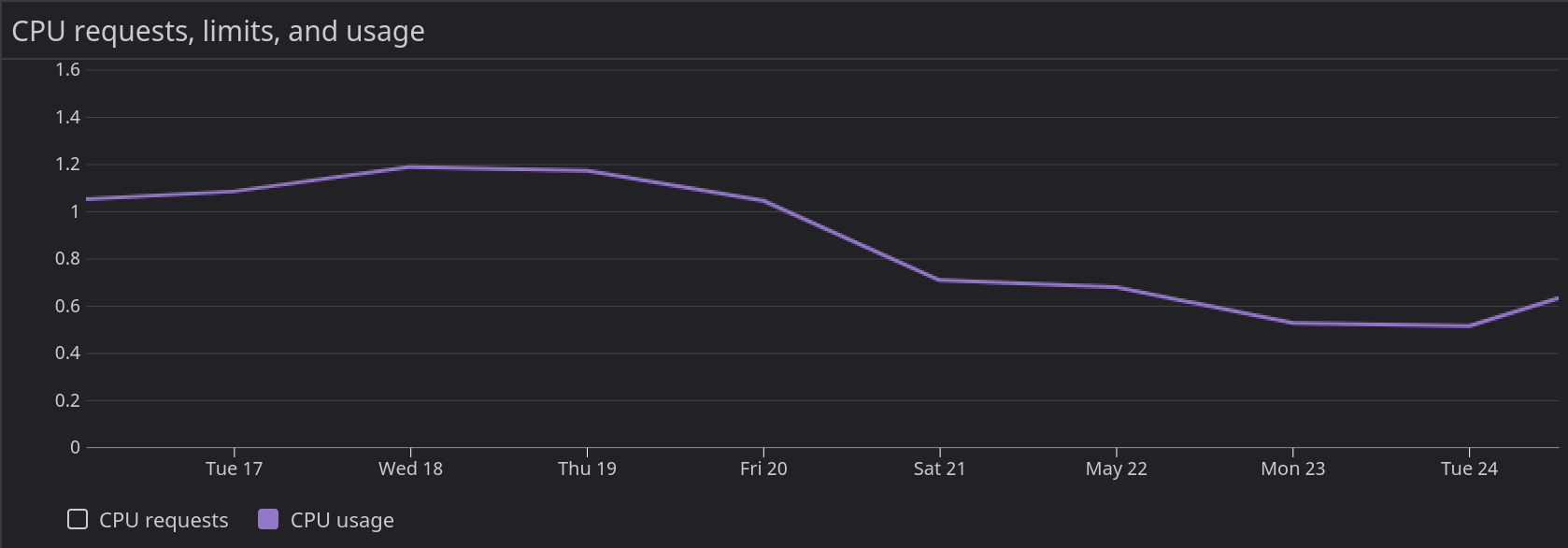
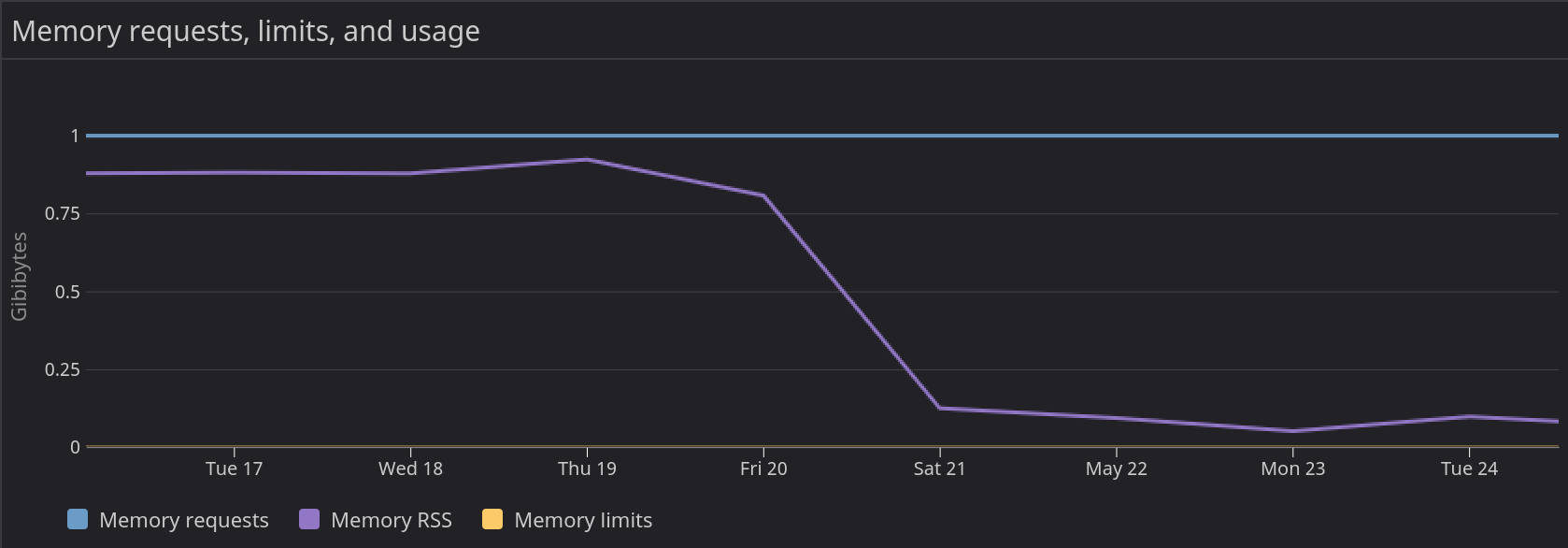
After releasing the updated cron job, we can see a sharp decline in memory usage and, surprisingly, a decrease in CPU usage too. To get a better idea of the impact of this refactoring, here is the CPU and memory usage during a larger time frame (February to July)
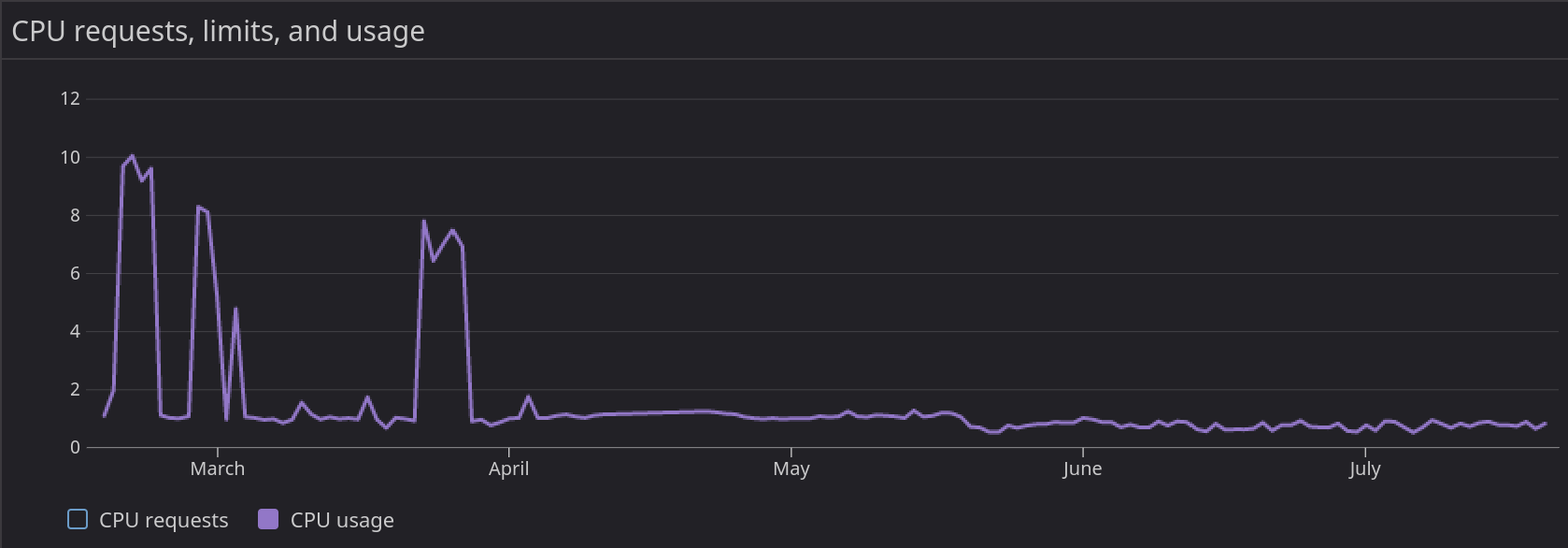
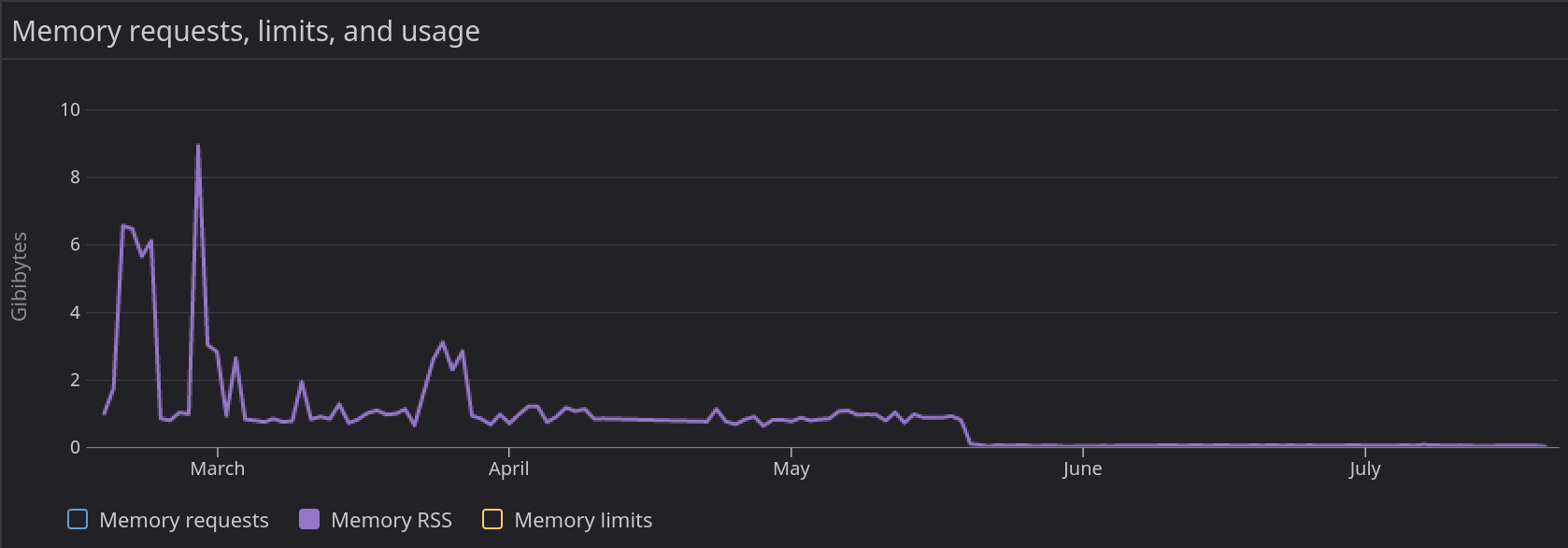
While CPU usage varies quite a bit, we can safely say that it has seen a 20% to 30% decrease. Memory usage on the other hand decreased by about 90% and is more or less stable at 100MiB.
Since we set out to avoid getting OOM Killed and reduce memory usage as much as possible, these results indicate that we can consider our refactor successful.
Finally, we also noticed one added benefit that we didn't set out to achieve and thus didn't expect: the cron job runtime was halved. Before this refactor the cron job took around 2 minutes to complete, while now it takes about 1 minute. While performance is not our primary concern, it was a nice surprise indeed.